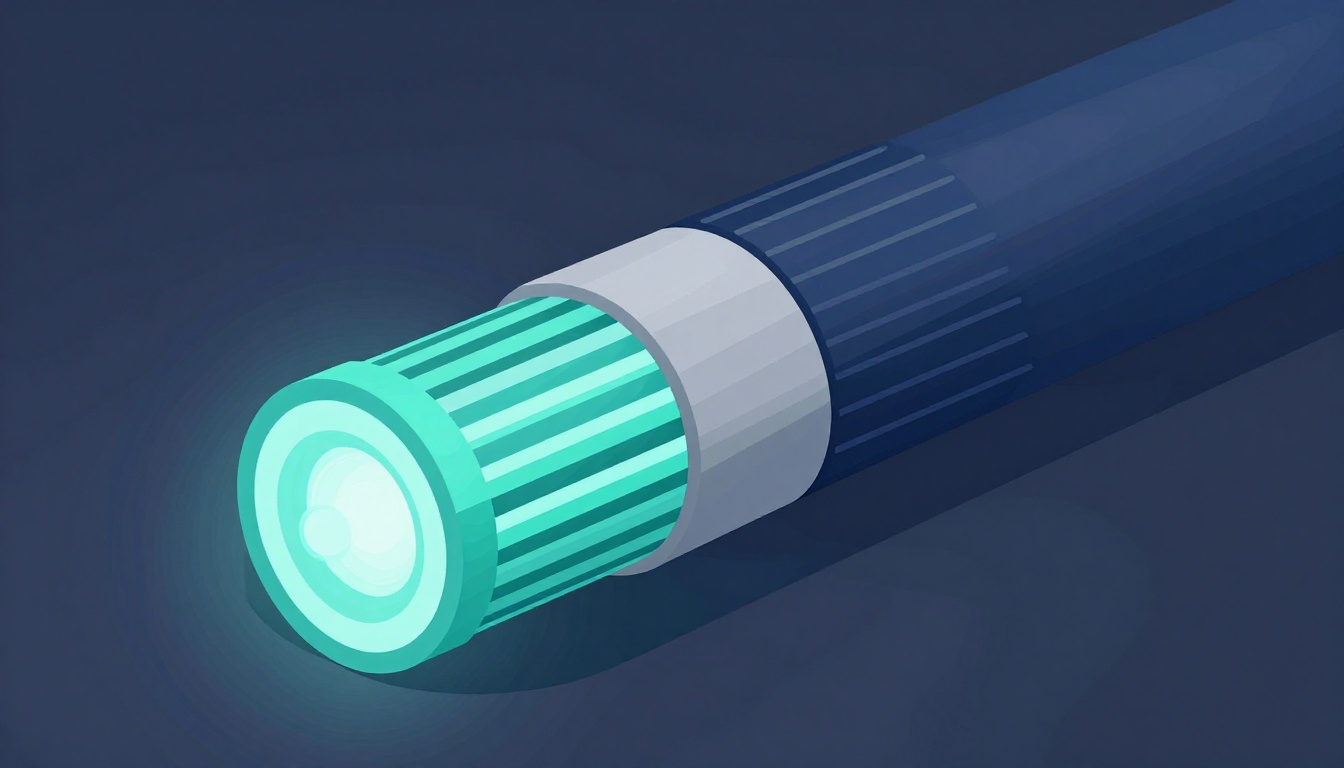
A fiber optic cable is like a high-speed highway for light. Instead of cars, tiny pulses of light carry data to your router, switch, or phone. That’s why the main parts of a fiber optic cable matter so much.
When those parts work together, you get fast internet, stable connections, and less signal loss than copper wires. Fiber also powers modern tech like streaming, data centers, and 5G backhaul.
Next, you’ll break down the cable piece by piece. You’ll learn how the core, cladding, coating, and the strength and jacket layers protect the fiber and keep data moving.
The Core: Where Light Carries Your Data
The core is the tiny center of the fiber. It’s usually made of glass or plastic, and it’s incredibly small, often measured in microns. (A micron is about a thousandth of a millimeter.)
Light pulses travel through the core. Think of it like a drinking straw. Your straw has one main path, so the drink moves through it. In fiber optics, the light follows the core’s route.
Because the core is so small, its design affects performance. In many fibers, manufacturers use materials and dopants to control how light behaves. For example, silica glass is common, and dopants like germanium can help shape the light path by changing the core’s refractive index.
Core size also influences speed and distance. Smaller cores reduce how much the light spreads out over long runs. As a result, signal loss stays lower, and the connection holds up better.
Here’s the tradeoff. A core that supports longer-distance travel can be harder to work with during installation. Still, it’s a big reason why telecom networks prefer single-mode fiber.

Single-Mode vs. Multimode Cores
Core design usually comes down to two main types: single-mode and multimode. The names describe how many light paths the fiber supports.
Single-mode fiber carries light in basically one path. Multimode fiber lets light take multiple paths at once.
That difference impacts distance, cost, and where you’ll see each type.
| Feature | Single-Mode Core | Multimode Core |
|---|---|---|
| Core size (typical) | Around 8 to 9 microns | Often 50 to 100 microns |
| Light paths | One main path | Many paths |
| Best for | Long distances, telecom backbones | Short runs, some enterprise links |
| Common use | Internet service providers, long-haul routes | Data centers, campus networks, indoor runs |
| Main downside | Higher cost per component and optics | More signal spreading over distance |
If you want a clear side-by-side explanation, this guide on single-mode vs. multimode fiber optic cables is a helpful refresher.
In real life, homes often use fiber for the last mile (from the local area to your building). That part may use single-mode for distance efficiency. Meanwhile, inside buildings, multimode sometimes appears because it can work well for shorter links.
Cladding: The Reflective Shield Around the Core
Right outside the core sits the cladding. The cladding is another layer of glass, but it has a slightly lower refractive index than the core.
That small difference gives fiber optics one superpower: total internal reflection. Light hits the boundary between core and cladding. Then it reflects back inward, instead of leaking out.
In other words, cladding acts like a reflective shield. Without it, light would escape and your signal would fade fast.
Another way to picture it is with a shiny tunnel. The light keeps bouncing along the inner wall, so it stays guided.

If you want the science in plain language, the FOA has a strong reference on total internal reflection in optical fiber. It explains why cladding prevents major signal loss.
Cladding isn’t just a “supporting layer.” It defines how well the fiber keeps light inside. When installers handle fiber carefully and keep bends within spec, the cladding helps maintain a stable path.
Also, cladding thickness matters for practical performance. It provides mechanical support and helps meet optical requirements. So even if the core is perfect, cladding still sets the real-world limit for loss and stability.
Coating and Buffer: Cushioning the Delicate Fiber
The fiber core and cladding are fragile. That’s why the next layers matter so much.
First comes a coating layer. This is usually a soft polymer right on top of the cladding. Its job is to protect the glass from tiny scratches and surface damage. Even small defects can cause higher loss later.
Then you may see a buffer layer. A buffer adds extra protection for handling and bending during installation. Importantly, the coating and buffer don’t guide the light. The core and cladding do that work.
In most installs, coating and buffer are what keep fiber splice points and connectors from getting damaged. They also reduce stress from normal cable movement.
There are two common ways fiber gets protected in bigger cables:
- Tight-buffer fiber: The buffer sits close around the fiber. It’s common in patch cords and short runs.
- Loose-tube fiber: Fibers sit inside tubes within the cable. The tube often uses gel to reduce stress and water effects.
In addition, many installers treat fiber like a wire you can’t see. They manage bend radius carefully. They also handle the fiber so the coating stays intact.
If the coating gets nicked during pulling, the damage can show up later as higher loss. So coating and buffer are not “just protection.” They help your network stay healthy.
Strength Members and Jacket: Built for Real-World Toughness
A bare fiber alone can’t handle real jobs. You can’t pull it through conduit, hang it near walls, or run it outside without support.
That support comes from strength members. Common materials include aramid yarns (often known by the trade name Kevlar), fiberglass, and sometimes steel. These parts resist pulling forces, crushing, and tension during installation.
Then the jacket goes on the outside. This layer acts like the cable’s outer shell. It can protect against moisture, heat, and physical damage.
Jackets vary by where the cable will live. For example, an outdoor jacket usually resists water and weather. An indoor jacket may focus more on fire safety and building codes.
If you want a good view of how cable design changes by environment, check out outside plant fiber optic cables. It breaks down how the full cable assembly protects fibers based on where you install it.
For jacket types, you’ll also see lots of variation in materials and construction. This overview of different types of fiber optic cable jacketing can help you connect common jacket choices with real install needs.

Strength members and jacket also affect how the cable handles multi-fiber builds. For example, some outdoor cables use loose tube designs inside a tough outer shell. That helps fibers stay aligned even if the cable moves.
Finally, you might spot extra features like ripcords or stiffeners. These make installation easier and reduce the chance of accidental damage.
Bonus Parts Like Buffer Tubes and Ripcords
Sometimes installers see more than just “fiber and jacket.” Many cables include handy extras.
Buffer tubes organize multiple fibers. They often contain gel, so fibers can move slightly without taking full mechanical stress.
Ripcords help strip back jackets quickly. Technicians can peel away the outer layer without cutting into the inner parts.
You might also find stiffeners in some builds. They reduce kinks during pulling. In distribution cables, a “stiffer” section makes it easier to route the cable neatly.
Some designs also add layers to reduce cross-talk. For example, dark glass or other internal materials can help keep light from wandering between fibers. That matters in high-density installs, where many fibers run side by side.
Materials That Power Fiber Optic Cables Today
When people ask what a fiber optic cable is made of, the answer is more than “glass.” It’s a stack of materials that each has a job.
For the light path, you typically see silica glass for the core and cladding. That’s why purity matters. Small impurities can increase scattering and loss.
Then you have plastic layers, like coatings, buffers, and jackets. Plastics protect the fiber and make handling easier.
For strength, you often see aramid yarns (Kevlar), fiberglass, or other reinforcing elements. Those materials handle tension and crush forces without damaging the fiber inside.
You may also see dopants in the core or cladding. Dopants tune the refractive index and help control how light stays guided.

If you want a practical guide that ties parts to materials, this breakdown of fiber optic cable components and materials is a solid starting point.
Now, look at what’s changing as demand rises. By March 2026, fiber development has been moving toward:
- Hollow-core fiber (HCF), which has air inside instead of solid glass. Some reports cite very low loss over long distances.
- Multicore fiber, which packs many cores into one cable, raising capacity without making the cable massive.
- High fiber count cables that fit huge bandwidth needs for dense networks and submarine routes.
AI data centers are also pushing major demand. Fiber supports high bandwidth with lower power use than many older approaches. At the same time, vendors keep improving cable density for more connections in less space.
So, even though the core, cladding, coating, strength members, and jacket still define the build, materials keep improving their performance and installability.
When you remember one idea, remember this: the cable is a system. The core carries light, and every other layer protects it.
Conclusion: How the Parts Work as One System
A fiber optic cable succeeds because its parts cooperate. The core sends light pulses. The cladding keeps those pulses from leaking out. The coating and buffer protect the fragile glass during handling.
Then strength members and the jacket make the cable survive the real world. They resist pulling, crushing, moisture, and harsh environments. Together, these layers help fiber deliver speed and distance with low signal loss.
If the opening hook felt true, here’s the next step. Take a look at a fiber cable jacket next time you’re near one. You’ll spot the extra layers and labels that hint at those inner parts.
And with trends like hollow-core fiber, multicore designs, and faster buildouts for AI networks, these “main parts” keep getting smarter. The light highway gets longer, steadier, and more packed, too.