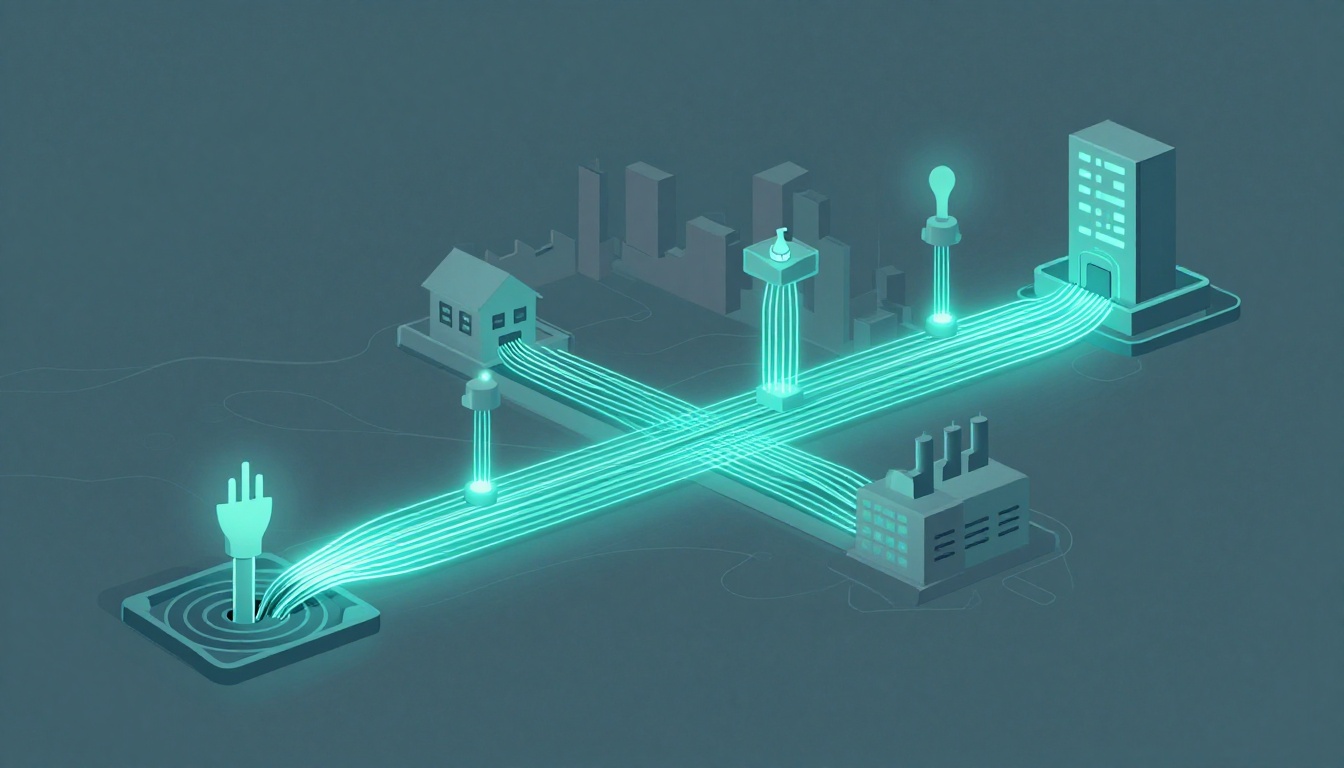
Ever notice how your video calls work while your neighborhood seems busy all day? That’s often fiber optic cables used in real life, sending data as pulses of light. Instead of relying on copper wires that can pick up interference, fiber carries signals with less signal loss and more speed.
In 2026, fiber keeps growing because people stream more, game more, and work from home more. That demand also spills into hospitals, factories, and the global networks behind the internet.
So where do these invisible superhighways actually hide? Keep reading to see the most common real-world places fiber shows up, from your living room to undersea cable routes and beyond.
Powering High-Speed Internet Straight to Your Home
Most people think fiber “starts at the internet company.” In practice, fiber optic cables in homes often start much closer, inside streets and utility corridors. From there, many networks use fiber-to-the-home (FTTH), which brings fiber all the way to your home’s connection point.
Why does that matter? Light pulses move through glass with fewer slowdowns. That helps with lag-free streaming, faster downloads, and smoother video calls. If you’ve watched 4K shows on Netflix or played online games with less buffering, fiber may be part of the reason.
In the U.S., fiber deployments have been moving fast. In 2025, deployments reached a record 11.8 million homes passed, and total FTTH passings hit 98.3 million. That’s over 60% of U.S. households. For 2026, the rollout momentum keeps building, especially through federal funding.
Programs like BEAD (Broadband Equity, Access, and Deployment) are pushing big construction waves. BEAD includes $42.45 billion from the Infrastructure Act, and it’s entering peak build years in 2026 and 2027. Some carriers also expect funding and incentives to stretch into overall network growth close to $30 billion, depending on state programs and partnerships.
Think of fiber like a clean water pipe. Old copper wiring is more like a garden hose with twists and pressure drops. Both move “something,” but one stays consistent, especially over distance.
Also, home tech keeps expanding. Smart thermostats, security cams, voice assistants, and doorbells need a stable connection. While not every device needs fiber directly, fiber is what helps the Wi-Fi and local network keep up. And if your city builds public Wi-Fi or adds camera networks, fiber backhaul is often the hidden layer behind it.
A good example of how BEAD money can turn into real installs is Alaska Communications expanding broadband in Alaska with NTIA BEAD support (see Alaska Communications BEAD grant expansion). It’s the kind of local build that keeps fiber from staying “theoretical.”

Fiber in Smart Homes and Cities
In smart homes, fiber works like the main hallway in a big apartment. Everything else can be smaller, but it still needs a strong route.
Here’s what that can look like:
- Voice assistants and smart speakers get quick responses because the cloud can reach them without long delays.
- Security cameras send video reliably, even during busy hours.
- Connected appliances (like smart locks or energy monitors) send updates without waiting forever.
Now zoom out to the street. Smart cities use fiber for more than just public internet. Traffic light systems, traffic sensors, and camera feeds often rely on high-capacity links.
When those systems work well, you feel it indirectly. Rush-hour traffic can move smoother, and response times for emergencies can improve because data gets where it needs to go faster.
In 2026, more households still need upgrades. That’s where the BEAD story matters. If you want a snapshot of how BEAD has changed across the year, Electrical Contractor Magazine shared a 2026 fiber optic update on BEAD (see What Happened to BEAD? 2026 fiber optic update). It’s a helpful way to understand why builds vary by region.
The Backbone of Global Telecom and Undersea Connections
Fiber isn’t only about home internet. It’s the core “highway system” behind telecom networks and the internet backbones that move massive data.
When you see 5G on your phone, fiber often provides the transport link from towers to the rest of the network. The same goes for cable TV, live broadcasts, and internet routes that support streaming services.
Here’s the real mind-bender: even though undersea cable sounds like one big cable, it’s really a web. Many cables, many landing points, and lots of routing decisions work together so your call or stream can cross oceans without falling apart.
Under the hood, fiber’s low loss and high capacity help networks carry huge amounts of data reliably. That’s why it’s the favored medium for long distances where copper would struggle.
In the undersea world, growth has been strong in 2026 because international traffic keeps rising. Realtime reporting puts international data sent between countries at roughly 95% to 99% via undersea cables. That’s most of the internet you use, even if you never think about oceans.
On top of that, network upgrades at home keep driving demand. DOCSIS 4.0 hybrids and other upgrades can boost speeds, but they still require strong fiber routes to feed neighborhoods and connect service providers.
Undersea Cables Linking Continents
Submarine fiber systems connect countries across thousands of miles. They don’t rely on “signal repeaters” the way people imagine from sci-fi. Instead, the system uses optical technologies built for long distances, with careful cable design and special fibers that handle the ocean environment.
It’s why undersea cable projects often get described as resilient infrastructure. When a cable lands, it becomes part of a larger switching and routing setup.
A fun way to think about it: these cables handle a huge share of international data traffic, often described as about 99%.
In 2026, new projects continue to push capacity and redundancy. If you want a concrete example, Extensia covered major milestones for the Medusa submarine cable system (see Medusa submarine cable system splice milestone). That kind of work keeps global links ready for growing AI and cloud demand.
And it’s not just “across the Atlantic.” Worldwide, there are over 500 undersea cable systems, totaling around 1.7 million kilometers. That’s enough to circle Earth many times.

Supporting 5G and Streaming Services
Your phone’s speed depends on multiple parts working together. Fiber usually handles the long-distance links and the backhaul. Then wireless equipment takes over locally, sending data to your device over radio.
Broadcast networks also rely on fiber for high-quality video transport. Sports and live events need steady streams, not “almost good enough.” Fiber helps keep those feeds stable, even when demand spikes.
That’s why, when you watch a game with minimal drops or take a Zoom call from a busy area, fiber is often behind the scenes. It’s like the stage crew in a theater. You might not see them, but the show runs because they handled the hard part.
In other words, fiber helps you keep moving in real time, even when the network is under stress.
Revolutionizing Medicine with Tiny, Precise Tools
Fiber isn’t just for internet. It’s also used in fiber optic cables in medicine, where light can travel through thin, flexible bundles.
One of the most visible uses is endoscopy. Picture a flexible flashlight snake. Doctors guide it into the body, and fiber carries light in. Then, the system uses light and optics to create images doctors can view during exams.
Because the probe can be thin, endoscopies often mean smaller incisions. That can lead to faster recovery and less pain for many patients. In 2026, the trend continues toward minimally invasive procedures and better imaging.
Laser procedures also use fiber. In some setups, fiber helps deliver pinpoint light to a targeted area. That makes it easier to treat certain conditions with greater precision than older methods.
Realtime reporting on 2026 medical tech highlights growth in minimally invasive surgery, improved imaging, and smart sensing. It also points to AI being used to analyze images faster, and to newer sensor systems that can monitor patient vitals.
If you want extra context on how fiber ties to endoscopy and medical diagnostics, this overview at Open MedScience explains fiber optics and endoscopy in medical diagnostics and surgery (see Fibre Optics and Endoscopy).
Endoscopy and Internal Imaging
Endoscopes rely on fiber bundles to light up the inside of organs. The same technology can support image capture, so doctors see what’s going on without major surgery.
In practical terms, fiber helps with:
- Illumination in tight spaces
- Image clarity for early spotting of problems
- Tool control during minimally invasive work
Then doctors combine what they see with other info like lab results. The goal is earlier detection and better decisions, not just a “quick look.”
For patients, it often means fewer days in the hospital. It can also mean less downtime afterward.
Laser Surgeries and Sensors
In laser treatments, fiber can guide light to the exact spot that needs attention. That matters when the area is small or sensitive.
Meanwhile, sensors can use light-based methods too. Some systems monitor changes in the body in real time. That can help teams respond quickly during procedures.
And outside the operating room, fiber-connected networks also support faster workflows. Clinics can share imaging and follow-ups more quickly when their internal systems have strong connections.

Driving Industry, Data Centers, and Secure Defense Networks
Fiber shows up where downtime costs money. Factories, pipelines, rail systems, and power grids use fiber to handle data from sensors and control systems.
Because fiber can carry data with less interference, it fits harsh settings. Think high electrical noise near heavy machinery. Fiber’s light signals can travel without picking up the same kinds of electrical problems copper wires face.
That’s why automation systems often depend on fiber links for reliable control and monitoring. Solar farms also need steady data from inverters and sensors. Oil and gas operators use monitoring to catch issues early.
Data centers are another huge user. They move massive amounts of data for apps, cloud storage, and AI training. In 2026, the AI boom is pushing fiber demand hard.
Realtime reporting highlights a startling comparison. One AI data center can need up to 10 times more fiber optic cables than a regular cloud data center. The math is simple: more servers, more connections, more traffic paths.
It’s also why fiber prices have jumped. Reporting notes that costs that were around $2.50 per kilometer in late 2025 rose to about $12 to $16 per kilometer, with higher-end AI fiber costing even more.
If you want an industry view of how vendors are responding, Fierce Network reported on major fiber vendors planning for huge demand from AI in 2026 (see Fiber vendors strategize for AI demand).
Factories and Energy Monitoring
In a smart factory, machines talk to each other. Sensors measure heat, vibration, pressure, and performance. Then systems send that data to control software.
Fiber helps when you need stable links over long distances. It also helps when you need consistent timing for control loops.
Energy monitoring uses a similar setup. Utilities rely on data from substations, smart meters, and grid sensors. When the system sees a warning early, repairs can happen before a small issue becomes a full outage.
Data Centers Fueling AI and Cloud
Inside data centers, fiber carries traffic between servers and storage systems. It can also connect separate zones and buildings.
With AI, data moves more than ever. Models need training runs, and inference still needs quick access to data. That means network demand rises, and cabling plans get more intense.
Realtime coverage notes that the U.S. needs more fiber routes, from about 95,000 miles to 187,000 miles by 2029. In addition, fiber traffic has surged in some cities by thousands of percent as new buildings go up and networks expand.

Exciting New Trends Shaping Fiber’s Future
So where does fiber go next? In 2026, several trends point to more fiber where you already need fast, stable connections.
First, AI pushes network planning. When companies train large models, they need capacity across many racks and many sites. That means denser cabling and more routes.
Second, there’s a focus on smaller and more efficient cable designs. Thinner cables can reduce material use and make installs easier in tight spaces.
Third, edge computing grows alongside IoT. When sensors and devices process some data near where it’s created, the network still needs strong links. Fiber helps keep those links dependable.
Finally, security remains a daily concern for IoT and connected systems. Even without getting into sensitive details, networks can use stronger design choices and monitoring tools when data flows depend on fiber.
And as more builds roll out, costs can come down over time. Better competition and larger scale can reduce prices for installs and equipment.
The big takeaway is simple. Fiber is turning into a standard layer, not a luxury upgrade. And you feel that in your home, your hospital visits, and the way businesses keep running.
Conclusion
Fiber optic cables used in real life show up in places you notice, and places you never see. In 2026, they power FTTH internet at home, support smart city systems, and carry global traffic under oceans. They also help medicine move toward smaller procedures, plus they support data centers that fuel AI and cloud tools.
If you want to connect the dots from this guide to your daily life, start with your own setup. Check your current internet speed, then look into FTTH upgrades if they’re available. And if you spot fiber in new places, share that discovery with someone curious.